A single prompt isn't enough to make AI replies sound like your brand. Good replies come from four steps: check, classify, answer, review. You define your brand voice with a few building blocks, from form of address and length to tone, vocabulary and how you sound when handling complaints. This article shows what that looks like in ZYBR.
“Does this sound like us?” Sooner or later, every D2C team hears this question from its brand managers when the first test replies come in from an AI helpdesk. Sometimes it's a quiet gut feeling, sometimes a clear no, sometimes a relieved yes.
Not losing your personality is the invisible yardstick automated service communication gets measured against. Lea Schimming, CEO of Monoka, describes what it feels like when that yardstick is met:
“By automating our email communication with customers, we saved a full-time position without losing any quality or personality in our replies.”
The good news: AI that sounds like your brand is no longer a matter of hope. The bad news: many brands are looking for the lever in the wrong place. They debate brand voice workshops while the real question sits deeper, in the architecture underneath the tone.
Why doesn't AI always sound like you?
An industry analysis by Shelf estimates that around 27% of all chatbot answers contain factual drift. That's not “the AI sounds odd”, that's “the AI says the wrong thing”. Most brands that pilot their first AI replies run into the same pattern: the problem isn't the brand tone but the structural question of whether the AI fully carries out its instructions in the first place.
Two examples from our own early days:
A customer writes in German. Her name sounds foreign, let's say Polish. The instruction to the model is clear: reply in the language the customer wrote in. Even so, the AI replies in Polish. That's not a branding problem. It's a question of whether this one explicit instruction reaches the model when a huge number of other instructions are passed along at the same time. That's exactly the scale needed to cover the variety of typical customer requests at all: cancellations, returns, shipping status, warranty claims, sizing advice, discount requests, store-specific policies, tone instructions. And those are just some of the categories.
Second example: a store's policy says customers can return items free of charge within 14 days. In one reply, the AI turns that into 30 days. Factually wrong, commercially risky. The frustratingly subtle part: otherwise the reply reads perfectly fine.
Both drifts followed the same pattern. The tone wasn't off. The instruction itself didn't get through.
And brand voice instructions are the first to drop out under this load. “Reply in German” can be checked hard: the language is right or it isn't. “14 days means 14 days” too: the number is right or wrong. “Sound like our brand”, on the other hand, is soft, with no clear tipping point and no binary check. When the model has to prioritize, exactly these tone guidelines are the first to go, long before hard factual instructions break away. Thinking about brand voice without the architecture behind it is the wrong order. Tone isn't the first lever, it's the last one that can take effect at all.
If you treat it as a pure tone problem anyway, with brand voice workshops and style guides, you're solving the wrong task and wondering why nothing improves.
What a robust AI reply really is
When a prompt tries to do too much
Both drifts from the last section had the same cause: the model got a single, monolithic prompt containing all the logic. With that many instructions in one go, a language model under load prioritizes in an uncontrolled way. Some instructions get through, others quietly drop out. That's not bad AI. It's too big a mouthful.
Approval, Categorization, Answer, Evaluation: what the AI really does
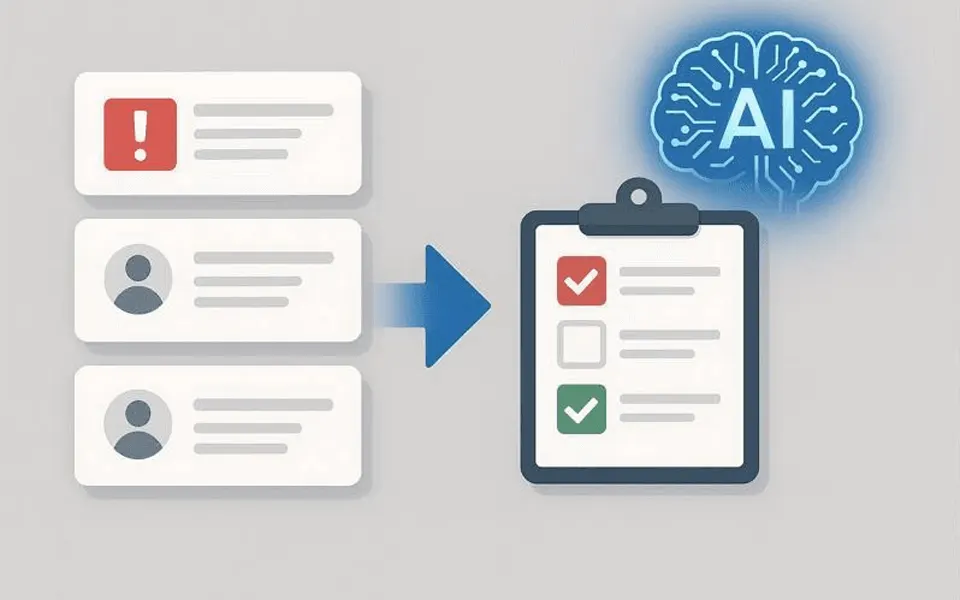
Instead, we don't talk to the AI just once per reply but several times, depending on how complex the case is. A spam email is filtered out in two steps. A simple service request typically goes through four dedicated LLM calls:
Approval: Is this request legitimate at all and within the defined service scope or is it spam, out of scope or a critical case?
Categorization: What exactly is it about: a cancellation, a return, a shipping question, a warranty claim?
Answer: Only now does the model write the actual reply, with the store-specific instructions and the retrieved data in context.
Evaluation: A final check that the reply meets the instructions before it goes out.
Between Categorization and Answer, the data gets fetched: order status, product information and store policies via a direct query to the Shopify integration, plus the current shipping status. Technically, that's not an AI step. The data arrives exactly and in real time, without a model having to “guess” it. That takes the most common source of hallucinations out of the game.
Structured prompt engineering empirically reduces hallucinations by up to 36%. In our experience the effect is even stronger, because every call is tailored tightly to its step. The model doesn't have to keep everything in mind at once. It gets the right question at the right time, with the right data to work from.
This is exactly where the groundwork is laid for the brand-specific instructions to still come through at the end. Here's what I have to say about it:
“I was once asked whether I could tell a ZYBR reply from a human service reply. Yes, I said, but by an unexpected marker: the AI reply is usually longer and contains more product knowledge, because it processes the complete store data in real time, while a service agent has to answer a pile of tickets under time pressure.”
This is the layer where brand voice starts to make sense at all. Structured categorization is the prerequisite. What it should look like is the next question.
Brand voice is a spec, not a feeling
Once the architecture is in place underneath, brand voice is no longer a vague exercise in tone. It becomes a concrete configuration of language parameters that gives the AI clear guardrails for how your brand communicates.
The components of a service brand voice
A brand voice is about more than whether a reply should sound formal or casual. In practice, several dimensions matter:
How you address customers: Should the AI address customers informally or formally or automatically pick the right form of address from the conversation so far?
Reply length: Short and direct or detailed and explanatory? Reply length can be fixed or automatically adapted to each request.
Tone: There's a wide spectrum between formal and casual. What matters isn't a rigid style but the position that fits your brand.
Preferred terms: Which words belong to your language? Do you say “drop” instead of “product”, “routine” instead of “care” or do you use terms all your own?
Unwanted terms: Which phrases should deliberately never show up in your service replies?
Value verbs: Verbs like “take care of”, “solve” or “check” carry different attitudes and shape the character of a reply more than you'd think at first glance.
Speaker perspective: Does your brand communicate as “we”, in the first person or on behalf of the team?
Escalation tone: Especially with complaints or critical cases, a brand may need to sound different than in everyday service: factual, empathetic or deliberately de-escalating.
These settings don't produce a rigid text template. Instead, they form the language guardrails that shape every reply the Assist writes.
Example: D2C beauty versus streetwear
The same request, “Where's my package?”, sounds completely different at two brands. A beauty brand might reply: “Dear Anna, we understand that waiting is no fun. Your package left our Hamburg warehouse this morning and should reach you within the next two business days.” A streetwear brand writes in the same situation: “Hey Anna, your drop's been on its way since this morning. Tracking update in 24h. Sorry for testing your patience.” Both replies are correct, both are friendly, both come from the same engine. And each sounds like exactly one brand.
Configure your brand voice directly in ZYBR
These exact language guardrails can now be configured directly in ZYBR.
In the brand voice settings, you define how your Assist should communicate with customers: from the form of address, reply length and where you sit between formal and casual to preferred and unwanted terms.
You can also define so-called value verbs. Words like “take care of”, “solve” or “check” look like small details at first glance, but they shape how your brand is perceived considerably.
You can set the speaker perspective too: should communication be in the “we” form, the “I” form or on behalf of the team?
For sensitive situations, there's a dedicated escalation tone. That lets the Assist respond to critical requests in a deliberately factual, empathetic or de-escalating way, without every single situation having to be spelled out manually as a prompt.
The brand voice is built into reply generation as a concrete prompt instruction. So the tone slider isn't a randomness or creativity parameter of the language model but a clear language guideline for how replies should be written.
The goal behind it is simple: you shouldn't have to describe your brand voice in long free-text instructions. You define the key guardrails once in a structured way and the Assist then takes them into account in every reply.
The fastest way to hear how your brand voice sounds in real replies is with your own requests: try ZYBR with your own customer emails.
Hybrid modes as a safety net and why audits are a must
Even with architecture and briefing, AI is still AI. That means hallucinations can't be ruled out technically, only controlled. For that, there are two modes that can be configured per request category.
In human-in-the-loop mode, the AI generates a reply as a draft and a service agent reads it, adjusts it and sends it. That's the cautious default for requests with tone risk or legal sensitivity: escalations, warranty claims, critical complaints.
In full automation mode, the system sends the reply itself, without a human touch in between. This makes sense for clearly defined, frequently recurring standard cases where the model delivers reliably throughout. Configurable per request category. Spam is handled differently from warranty claims.
Whichever mode you use, regular spot checks remain a must. Our AI Addendum explicitly requires them. These audits are exactly where voice drift like the Polish example from the first section gets caught today. The models have gotten better and it happens less often, but never zero. Anyone who treats “full automation” as “set and forget” creates a reputation risk that even the best briefing can't cushion. Hybrid AI in practice means both modes side by side, not one after the other, plus the spot checks in between.
So much for the architecture. That leaves the question of how much briefing work it actually takes on your end.
Briefing reality at ZYBR (and why it's easier than you think)
A bit of honesty at this point: in our first years, a good ZYBR setup really was work. We had long forms, a lot of back and forth with brands and alignment meetings that took hours. Today, the architecture does most of the work itself. The categories are proven, the data flows are in place and the model already hits a solid standard tone, even if you only give it a few guidelines.
With the brand voice configuration, you can tailor this standard to your brand. Form of address, reply length, tone, preferred and unwanted terms, value verbs, speaker perspective and the tone you want for escalations can all be set directly.
What's left beyond that are genuine special cases: an unusual shipping rule, a very specific phrase, internal industry slang or a quirk that only applies to your store.
That remaining bit is exactly the difference between a good service AI and an AI that truly communicates like your brand.
On day one, the basic setup is in place. Refinement then happens iteratively, as soon as you've seen the first real replies.
In other words: you don't need to know everything before you get started. You just need to know where your brand should stand out.
What staying on-brand in AI customer service really means today
Not losing your personality: that was Lea's yardstick in the first paragraph. Brand voice workshops aren't the problem here. They just solve the wrong thing. An on-brand AI reply is built from two layers. The first is an architecture that lets every instruction come through cleanly, including the brand-specific ones. The second is a briefing that defines what makes you special. Klarna handles two thirds of customer requests automatically, in under two minutes per case (as of 2024). AI customer service at that scale has long been standard practice. And Google's E-E-A-T update from March 2026 measurably weights authentic, competent voices higher than generic AI output.
Sources
Shelf, “Stop AI Hallucinations: A Developer's Guide to Prompt Engineering”, 2024. https://shelf.io/blog/stop-ai-hallucinations-a-developers-guide-to-prompt-engineering/
Klarna AI Assistant (official press release), Klarna, 2024. https://www.klarna.com/international/press/klarna-ai-assistant-handles-two-thirds-of-customer-service-chats-in-its-first-month/
E-E-A-T March 2026 Update, Digital Applied, 2026. https://www.digitalapplied.com/blog/e-e-a-t-march-2026-google-rewards-experience-content-guide
ZYBR AI Addendum, AI-Com Innovations GmbH. https://zybr.ai/ai-addendum

Paul Lory, Founding Partner and Technical Advisor
Paul Lory is Founding Partner and Technical Advisor at ZYBR. He has worked alongside the engineering team since the start and knows the architecture behind the multi-step AI replies described here from hands-on experience.