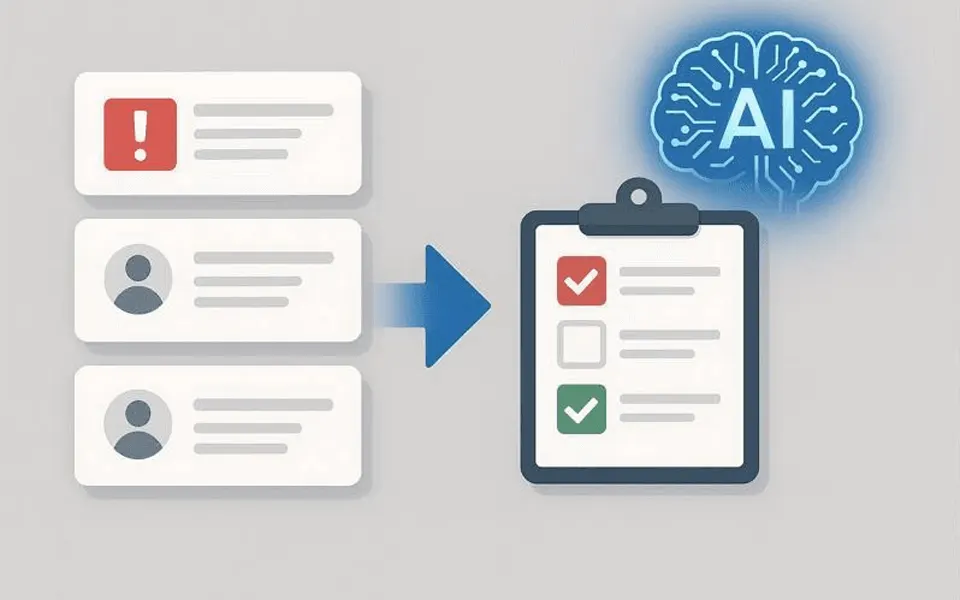
AI-based systems are fundamentally changing customer service. Companies like Klarna and H&M are achieving measurable efficiency gains through automation and personalization. At the same time, there are challenges around empathy, integration and control. This article weighs the opportunities against the risks and shows why hybrid models are key.
Boosting customer service efficiency with AI
One decisive advantage of AI in customer service is its ability to boost efficiency significantly. Companies like Klarna show how much potential lies in it. There, the AI assistant now handles around two thirds of customer requests. That's comparable to the workload of several hundred full-time employees.
Requests are automatically answered, classified and prioritized, cutting the average handling time from eleven minutes to under two. Over the same period, the number of repeat requests dropped significantly. Besides easing the operational load, this also led to substantial cost savings in customer service.
Other major e-commerce companies are seeing similar effects. AI isn't just used to answer questions but as the main control element in the service process.
Personalized replies as a competitive advantage
Alongside speed, personalization is becoming more and more important. Advanced AI systems use order histories, shipping information, customer preferences and internal policies and connect this data in real time.
The result is replies that aren't just correct but also fit the context. Customers get concrete solutions instead of generic boilerplate. In highly competitive markets, this has a direct impact on customer satisfaction and loyalty.
Another aspect is being proactive. Without waiting for a direct request, AI can identify likely follow-up questions or suggest suitable products. That way, customer service becomes not just reactive but also a proactive part of the buying process.
Another plus is consistent quality. While the quality of human replies depends on workload, it stays constant with AI. Customers get the same level of service regardless of the time of day or the volume of requests.
Spotting problems early and expanding globally
AI systems work proactively by continuously analyzing interactions and recognizing patterns that point to potential problems. Delays, repeated complaints or an escalating tone can be spotted early. That way, action can be taken before conflicts arise.
Then there's the question of language. Systems like Klarna's communicate in more than 30 languages and adapt replies in language and content to regional specifics. This makes international customer service possible without a proportional increase in headcount and improves customer loyalty worldwide.
Challenges and limitations of AI
Despite the benefits, there are clear limitations. One of the most serious is the lack of emotional intelligence. AI can imitate tone, but it doesn't truly respond with empathy. In emotional or conflict-laden situations, many customers still prefer to talk to a human.
Trust is another essential factor. Automated replies on sensitive topics like payments, data privacy or complaints can feel impersonal or inadequate to some customers. Technology alone can't completely solve this perception.
On top of that, integrating AI into existing systems is challenging. Effective AI solutions require a clean connection to CRM, store and ticket systems. Missing processes and a lack of control create new sources of error.
Finally, there's a small remaining risk of unpredictability. Anything that can't be foreseen or deviates from the norm still needs human oversight and regular adjustments to the systems.
Prompt engineering and ongoing management as the solution
Prompt engineering is a decisive lever for controlling quality. The tone, clarity and relevance of replies are strongly influenced by how you instruct the AI. Setting targeted guidelines lets you achieve consistent, factual replies that feel more human.
Ongoing management of the systems is also hugely important. AI needs oversight, adjustments and regular improvements. Models that use AI to automatically hand complex or emotional requests over to human agents are especially effective.
This creates a partnership between automation and oversight that combines the strengths of both sides.
See how drafts for your team and automatic replies per topic work together, using your own requests: try ZYBR with your own customer emails.
Costs and business case
Introducing AI takes some effort upfront. Resources are needed for integration, customization and training. In the long run, however, many companies report significant savings thanks to lower staffing costs and higher efficiency.
Smaller businesses have an easier entry point today than in previous years. Modern no-code and API-based solutions lower the barriers considerably. That makes AI economically worthwhile not just for large enterprises but also for up-and-coming e-commerce businesses.
The main upsides are lower costs, better scalability and more stable service quality as request volume grows.
Conclusion
The changes AI is bringing to customer service are plain to see. It improves efficiency, makes room for personalized communication and takes pressure off service teams. But it doesn't fully replace human empathy. The best results come where AI is used with structure and clear limits.
A hybrid approach, where AI handles the routine and groundwork and people take on complex or sensitive cases, is sustainable. Businesses that find this balance early secure efficiency, scalability and trust.
Approaches like ZYBR, which combine automation with a clear handover to human customer service, are an example of how AI can be integrated sensibly and in a controlled way into existing service structures.
Source for the figures on Klarna: Klarna press release, 2024.

Robin Wehner, Co-founder and Managing Director
Robin builds the AI behind ZYBR and thinks every system through, from the first draft to the finished reply. He spots edge cases before they happen. If something isn't right, it doesn't go live.