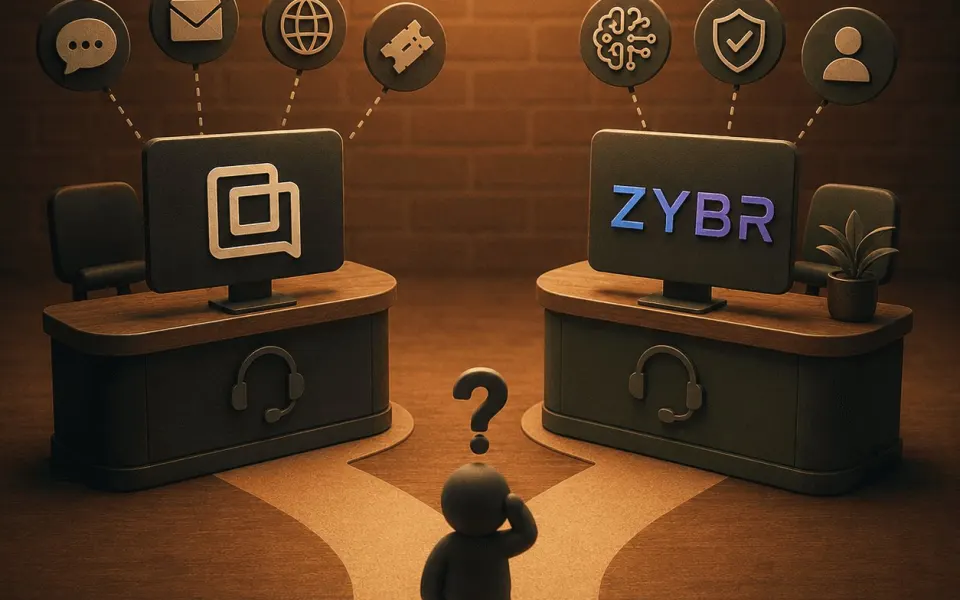
Both tools handle Shopify customer service, but with fundamentally different architectures, pricing logic and compliance profiles. This comparison puts both providers in context, lays out three clear decision scenarios and says openly when neither is the right choice.
What this comparison is about
If you're currently evaluating which tool should run your Shopify customer service, you probably have two names on the table: Gorgias and us. In its B2B Buying Report, Gartner put the average B2B SaaS buying process at around 84 days. A good chunk of that goes into figuring out whether one tool or the other is right for you. That's not efficient. And frankly, it's not necessary.
I'm writing this comparison from a position that's obviously not neutral. But it isn't arbitrary either: if you want to position ZYBR properly, you have to explain when Gorgias is the better choice. Otherwise the comparison is just marketing theater. That's exactly what I'm trying to do on the following pages: with verifiable sources, without badmouthing the other side and with a clear focus on the right question. Not “who wins” but which architecture fits which service reality.
Before you compare plans, it's worth taking a look at what you're actually comparing.
What Gorgias and ZYBR are, architecturally
Gorgias (Gorgias Inc., San Francisco) has been the established helpdesk market leader for Shopify brands worldwide since 2015. It started out as a classic multichannel helpdesk (ticketing, macros, workflow rules) and has its own AI agent as a separately billed module. If you ask for a “helpdesk” in English-speaking communities or at Shopify Plus agencies, Gorgias is usually the first answer. That's no accident: Gorgias is big, well established and has a dense partner ecosystem.
ZYBR is the younger answer from Berlin. Behind ZYBR is AI-Com Innovations GmbH, an engineering-driven team with a Shopify and e-commerce background. ZYBR is built exclusively for Shopify: we don't work with any other store systems, because we can only reach the depth we want within a single ecosystem. We built ZYBR from day one as an AI system that needs a helpdesk to work. Not the other way around.
This starting point shows most clearly where brands feel it first: in pricing.
Pricing logic: double billing vs. bundle
As of May 2026. All of the following figures can change at short notice; if in doubt, check the respective provider's website.
How Gorgias charges
Gorgias charges per ticket: you don't pay per agent but per number of conversations that get a reply in a given month. Plans start at around $10/month for 50 tickets and annual billing saves roughly 16%. That's one half of your bill.
The second half is the AI. Gorgias' AI module (listed as “AI Agent” on the pricing page) is billed separately. Depending on volume, that's around $1 per AI-resolved ticket, dropping to $0.30 to $0.75 per resolution at higher volumes. So you pay twice: once for the helpdesk, once for the AI.
Good to know: in Gorgias, a conversation counts as “billable” as soon as any reply goes out on it, whether from a human, a rule or the AI. Several independent industry analyses from 2026 describe this definition the same way (Eesel, Featurebase, see sources) and it matches Gorgias' own docs: a ticket counts as billable as soon as a message leaves the helpdesk, whether from a human, the AI Agent or a rule (Gorgias help docs on the billable ticket definition). For your own calculations, it's worth looking there directly. The practical consequence: if the AI resolves your ticket on its own, it still counts as a billable ticket and also as an AI resolution.
How ZYBR charges
ZYBR has three plans with included AI replies and one bundled price. STARTER costs €45/month (€459 on the annual plan, so €38.25/month) and includes 250 AI replies. GROWTH costs €399/month with 2,000 included replies. SCALE costs €1,799/month with 10,000 replies. If you need more replies, you pay overage at €0.25/€0.22/€0.19 per reply, decreasing with the size of your brand.
All features are available identically in every plan. We don't gate features between plans: what you get in STARTER (full automation, Shopify data in the ticket, supplier chat, all channels), you also get in SCALE. The difference is volume, not functionality. If you want to calculate the ROI honestly, you can run the numbers in under a minute in the ROI calculator on the pricing page.
When each model makes sense financially
Frankly, the math is unspectacular. If you have few tickets and only a small share of them can be handled by AI (so lots of human handling, with AI as an occasional booster), the Gorgias model can work out cheaper. If you have many tickets and want to automate a large share of them, the bundle model with included AI replies usually comes out cheaper, because you don't pay for every AI resolution individually. The exact threshold depends on your mix. This is exactly the point where you calculate rather than guess.
Pricing is the tip of the iceberg in numbers. The question behind it is how much AI is actually inside.
Architecture: what we mean by “AI-native”
At ZYBR, the AI doesn't sit on top but in the middle. Tickets, order data, tracking, returns, supplier chat: all of it was built from the start as context for the AI, not as a separate data source. That's why we don't say “the AI helps out in some cases” but rather: two clearly separate modes, human in the loop (AI generates a draft, a human sends it) or full automation (AI replies on its own), configurable per request category.
How other providers have built their AI modules varies from provider to provider. Our own experience as brand operators looks like this:
Back when Robin (CEO of ZYBR) was still running his own Shopify store for winter products, he used a classic helpdesk tool with AI suggestions. After the third “Where's my order?” loop in a single morning, it was clear to him that a suggestion you still have to click through isn't an AI workflow but a slower manual workflow with extra AI bureaucracy on top. That's exactly the gap we later closed with ZYBR as an AI-native system. Not because suggestions are bad, but because “replying” and “suggesting” are two different workflows.
For us, that's the decisive point: everything else follows from it. If you want to read more about the architecture question of “why substance matters more than feature lists”, you'll find the bigger picture in our copycats article. And if you want to understand how hybrid AI works in customer service, you'll find the bigger picture there.
Whatever architecture a tool has under the hood, your brand needs to be live tomorrow. That's where you notice the difference in day-to-day operations.
Setup & time to value
ZYBR is live from day one. You connect your Shopify store, ZYBR reads in orders, product catalog and store policies and knows the current shipping status, you give a short brief on your brand tone and from then on the system runs. If you want to go live faster, you can refine the brand brief afterwards. The standard configuration already works.
Gorgias gives you lots of dials to turn: macros, tags, workflow rules, routing, channel configuration. In conversations with DACH brands, we often hear that initial setups like these can take several days to weeks. That's anecdotal, not a statistic. The actual duration depends heavily on how deep you want to configure. With a Shopify Plus partner at your side it goes faster, but costs extra.
For a GROWTH brand under Q4 pressure, that makes a real difference day to day. If you decide in September and Black Friday is in November, there's no room left for 6 weeks of setup. But going live fast only helps if your data protection officer signs off on the contract. Which brings us to the second DACH reality.
EU compliance: GDPR, DPA and AI Act
In 2026, GDPR and the EU AI Act are no longer lifestyle questions. Especially not if you're a German D2C brand working with a data protection officer or facing an audit.
Contract framework: We work with EU contract partners as processors under Art. 28 GDPR, both for hosting our customer database in an EU region and for the AI models we use. If data has to be transferred to third countries, this is safeguarded through the mechanisms provided for in the GDPR (Art. 45 and Art. 46 GDPR). We're happy to share the full list of subprocessors with their current processing regions on request. That's standard practice and quicker than we could ever list it completely on the blog.
Training policy: We don't use customer data for AI training. This commitment isn't just marketing; it's anchored contractually in three separate places: in the data processing agreement (DPA), in our technical and organizational measures (TOMs) and in the privacy policy. A commitment written into three contractual documents is more robust than a note you only find in a single footnote.
EU AI Act: ZYBR is classified as a “limited risk” AI system, with ready-made transparency templates for Article 50. That means: if your data protection officer wants to see the disclosure obligations toward end customers (notice of AI processing, opt-out, etc.), the template is already there. You don't have to draft it yourself, you just adapt it. More on this in our AI Addendum with Art. 50 templates.
Gorgias is organized as a US company. As of May 2026, its specific EU compliance setup is described less explicitly in its public docs than ours. That doesn't mean it's worse. If you're evaluating Gorgias and have compliance questions, ask sales directly about the GDPR DPA, AI Act status and specific processing regions. That's legitimate and standard due diligence. And of course it applies just as much when you evaluate us.
The quickest way to grasp these points is in an overview.
Comparison matrix at a glance
The following table condenses the previous sections. It's not meant to decide but to sort. All time-sensitive values as of May 2026.
| Dimension | Gorgias (public docs as of May 2026) | ZYBR |
|---|---|---|
| Pricing logic | Helpdesk fee + AI billed separately | Bundles with included AI replies |
| Own description of architecture | Helpdesk + separate AI module (Gorgias pricing page separates “Helpdesk” and “AI Agent”) | AI-native system with a helpdesk container |
| Setup time | Several days to several weeks, according to anecdotal brand reports | Live from day one |
| Contract structure | US company (Gorgias Inc., San Francisco) | EU contract partners as processors under Art. 28 GDPR; customer database in an EU region; third-country transfers safeguarded under Art. 45/46 GDPR |
| EU AI Act | Not detailed in public docs as of May 2026 | “Limited risk” + Art. 50 templates |
| AI training policy | Not detailed in public docs as of May 2026 | No AI training on customer data, anchored contractually in three places |
| Language/market | English first, global market leader | DACH first, German depth |
| Channels (per provider website) | Email, chat, social, voice, SMS | Email, WhatsApp, Instagram, Facebook Messenger |
| Feature distribution | Tier-based feature gating (per Gorgias pricing page) | All features identical in every plan |
| Modes | “AI Agent” as a module (per Gorgias pricing page), mode configuration not detailed in public docs | Human in the loop + full automation, configurable per category |
A table sorts. It doesn't decide. Three scenarios help you go further.
A table is no substitute for a test with real requests: try ZYBR with your own customer emails.
Three decision scenarios
When Gorgias is the better choice
If you're a globally scaling brand running a dedicated service team with complex voice and SMS workflows and want AI as an add-on to your established helpdesk, Gorgias is a very sensible choice. You get an established tool, a dense partner network, broad channel coverage and market leader status that builds trust in many purchasing decisions. If you run multilingual global operations and your team is trained on US-centric workflows, Gorgias will serve you well.
When ZYBR is the better choice
If you're a DACH D2C brand, take compliance seriously, want to go live fast and want AI as your central reply engine, we're the right tool. Specifically: German is your home language, GDPR and the EU AI Act aren't up for negotiation, Shopify is your only ecosystem and you want to go live this quarter rather than next. Lea Schimming, CEO at Monoka, put it this way after the rollout: “By automating our email communication with customers, we were able to save a full-time position without losing any quality or personality in our replies.” If you want to work out what that means for your own brand, you can run the numbers in the ROI calculator. The figures come from your Shopify, not from our marketing.
When neither is the answer
If your ticket volume is below roughly 50 requests per month, you don't need Gorgias or us. A good email workflow with a well-organized inbox, maybe a light helpdesk like HelpScout in its smallest version. That's enough. Tool investments don't pay off against staffing costs that aren't there.
Once you've decided to switch, in whichever direction, the unpleasant part begins.
The reality of migrating
Tool switches are rarely as smooth as they look on paper. According to industry analyses, real migrations typically cost 2 to 5 times the annual subscription and experience shows that teams need 3 to 6 months to get back to their old productivity with a new tool. That applies to every helpdesk switch, not to one in particular.
With us, the fast setup cushions part of this load: the tool is running before the old tickets have even moved over. So your team can work in the new system in parallel. One concrete recommendation for the trial: don't run the test on demo data but on the real tickets coming in over the next two weeks. Only then will you see how the tool handles your brand's reality. Not the reality a demo dataset suggests.
Try ZYBR for yourself
Instead of calculating, just try it: use ZYBR free for 14 days, with 500 AI replies included. No credit card, the trial ends automatically. If it's not right for you, you won't hear from us again after 14 days. If it is, you'll know in the first week.
14 days free trial · Open the ROI calculator
Sources
Gartner B2B Buying Report, Gartner, 2024. emt.gartnerweb.com
Gorgias Pricing Page (as of May 2026). gorgias.com/pricing
Gorgias help documentation: “What counts as a billable ticket or automated interaction?” (primary source for the billable ticket definition, as of May 2026). docs.gorgias.com
Gorgias AI Pricing Calculator, Eesel. eesel.ai
Gorgias Automate AI Agent, MyAskAI 2026. myaskai.com
Gorgias Pricing, Featurebase. featurebase.app
Industry analyses on SaaS migration costs and tool switching (structural order of magnitude, aggregated from several sources; reference frame includes the ChartMogul SaaS Benchmarks Report 2023). chartmogul.com
ZYBR pricing page, AI-Com Innovations GmbH. zybr.ai/pricing
ZYBR AI Addendum. zybr.ai/ai-addendum
As of May 2026. All information about Gorgias in this article is based exclusively on sources publicly available as of May 2026 (see sources above). We aim for factual comparability; should we need to clarify a statement, we'll correct it promptly after a note to info@zybr.ai. Pricing and competitor information can change at short notice.

Paul Lory, Founding Partner and Technical Advisor
Paul keeps operations stable, secure and fast. He spots risks early, reviews every change to the system and makes sure the platform stays lean even under load.