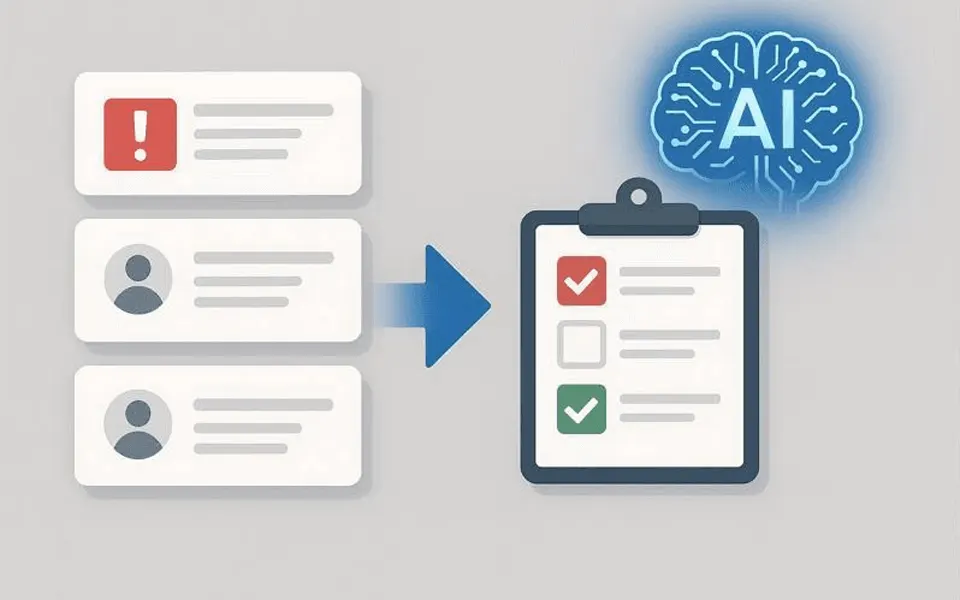
Tuesday morning, 40 open emails. One of them is a complaint with full name, address and order number. Someone on the team copies the entire email into ChatGPT, types “Write me a friendly reply” underneath and ten seconds later has a usable draft.
Exaggerated, but not made up. We know shops that work exactly like this: email in, reply out, back to the customer. And in everyday work we receive emails ourselves where you can tell, because the sentences ChatGPT wrote only for the sender were copied along too. And it is not a niche topic. According to a 2026 Bitkom survey, 71 % of people in Germany who use AI use ChatGPT. 12 % of those who use AI at work do so without their employer knowing.
The question almost nobody asks: Are you even allowed to do that? And if not, how do you get the time savings without handing over your customers' data?
That is exactly what this article is about. You will learn what happens to the data depending on the ChatGPT plan, which five questions every AI tool in customer service has to answer and what you can do today if your team already uses ChatGPT.
The honest answer starts with a counter-question: Which ChatGPT?
The short answer: It depends on your ChatGPT plan
With a personal account, meaning Free, Go, Plus or Pro, pasting customer data is, in our assessment, as a rule not GDPR compliant. With ChatGPT Business, Enterprise or the API and a signed data processing agreement, it can be.
The reason is not the language model. It is the contract you have with OpenAI, or don't have. “ChatGPT” is not a single product but a family of plans, and they differ exactly where it matters for data protection:
| ChatGPT plan (as of October 2026) | Training on your content | Data processing agreement (DPA) | Role of OpenAI |
|---|---|---|---|
| Free, Go, Plus, Pro | possible, you can opt out | not for regular chat use | independent controller |
| Business, Enterprise | no by default | available | processor |
| API | no by default | available | processor |
Two terms from the table decide everything. A processor processes data only on your behalf and according to your instructions, just as a hosting provider stores your data only for you. This is governed by a contract under Art. 28 GDPR, which OpenAI calls a “Data Processing Addendum”. An independent controller, by contrast, decides for itself what happens to the data. With the personal plans, that is exactly what OpenAI is: for users in the EEA, OpenAI's own privacy policy names OpenAI Ireland Limited as the controller.
For your shop this means: as soon as a customer email lands in a personal account, you pass your customers' data on to another company that processes it according to its own rules. With Business, Enterprise and the API, OpenAI instead works on your behalf once the data processing agreement is signed, and training on your content is switched off by default.
A footnote, so the table is not less precise than reality: since July 2026 there has been a data processing agreement for “ChatGPT Sites” for Plus and Pro. It only covers data collected by a published site, not your input in the chat.
What this means in practice becomes clear when you look at the personal account.
What happens to customer data in a personal ChatGPT account
Three things happen when a customer email lands in a personal ChatGPT account.
The content may be used for training. OpenAI itself states that it may use content from the plans for individuals to train its models. You can opt out: under Settings > Data controls, switch “Improve the model for everyone”, or via OpenAI's privacy portal. The opt-out only applies to new chats, though. And there is an exception hardly anyone knows about: anyone who rates a reply with thumbs up or down allows OpenAI, according to its own statement, to use the entire related conversation for training, even with the switch turned off.
The content stays stored. Chats remain in your account until you delete them. After deletion, OpenAI plans to delete them permanently within 30 days, unless they have already been de-identified or must be kept longer for security or legal reasons. The “temporary chat” is not ephemeral either: it does not appear in your history and is not used for training, but OpenAI may keep a copy for up to 30 days.
You pass on the data without a contract. This is the real sticking point. In a personal account, OpenAI by its own account decides on the purposes and means of processing. In our assessment, OpenAI is then not your service provider but an independent controller to whom you transfer customer data. For that you would need your own legal basis under Art. 6 GDPR, and that is hard to find for a complaint email. The Datenschutzkonferenz, the body of the German data protection authorities, often sees a processing relationship with external AI services and concludes: a contract under Art. 28 GDPR must be concluded with the provider. That very contract does not exist in a personal account. The Datenschutzkonferenz also considers applications “preferable” that do not use inputs and outputs for training, and explicitly recommends using business rather than private accounts for work.
On top of that comes a practical problem. If a customer wants to know what data you have stored about her, or requests its deletion, you also have to keep track of the copies in your team's ChatGPT accounts. With personal accounts you have neither access nor control.
How such tools can be used sensibly in customer service and where their limits are, we described in AI in customer service: efficiency and limits. For data protection, above all you need a clear framework for checking.
Five questions every AI tool in customer service has to answer
Whether ChatGPT, another chatbot or a helpdesk with built-in AI: five questions quickly show you whether a setup is risky. They do not replace a full review, for example of the legal basis and security measures.
1. Is there a data processing agreement?
A data processing agreement (DPA) under Art. 28 GDPR stipulates that the provider processes your customer data only on your behalf. Without a DPA, a service that processes customer data on your behalf cannot be used properly. For ChatGPT it exists for Business, Enterprise and the API, but not for regular chat use with personal accounts.
2. Is training on your data excluded?
A switch in the settings is good, a contractual exclusion is better. A switch can be forgotten, reset or never flipped by a new team member. A contract applies to all accounts and every chat.
3. Where is data processed and stored?
A contracting party based in Ireland does not automatically mean the data stays in the EU. OpenAI itself writes in its privacy policy that it processes data on servers outside the EEA and safeguards these transfers through adequacy decisions or standard contractual clauses. OpenAI offers data residency in Europe, but only for ChatGPT Enterprise, Edu and the API, and with conditions. According to the pricing page, ChatGPT Business is not included (as of October 2026). So ask every provider: In which data centres do the models run, where is the data stored, and how are transfers to third countries safeguarded?
4. How long is the data kept?
Good providers name clear deletion periods. Pay attention to what happens after deletion and whether copies, for example for abuse monitoring, are kept longer. “No storage” is the exception, not the rule.
5. Do your customers know about it?
If you use AI in customer service, it belongs in your privacy policy. Since 2 August 2026, transparency obligations under Art. 50 of the EU AI Act also apply. The obligation to inform people about the AI interaction initially falls on the providers of the AI systems. Whether anything beyond that applies to you as a shop also depends on whether the AI replies on its own or a person approves every reply. If in doubt, have it checked.
Quick check for every AI tool: DPA in place? Training contractually excluded? Data centres and third-country transfers known? Deletion periods clear? Privacy policy updated?
Your team already uses ChatGPT? Here is what to do now
When it comes to data protection, we see shops going in every direction. Some are really well set up, some don't care about the topic, and many would like to do better but don't know how, for example what a DPA actually is. If you recognise yourself in the last group: you don't have to solve everything at once. Four steps are enough to start.
1. Take stock. Ask your team openly who uses which AI tool for what, with a personal or company account. Without blame, otherwise you won't learn anything. If customer data is already in personal accounts: switch off training, delete the chats and record what was pasted when.
2. Write down a clear rule. For example: No customer data in personal AI accounts. That already puts you ahead of most: according to Bitkom, in 2025 only 23 % of companies with 20 or more employees had any rules for AI tools at all.
3. Remove data in the meantime. As long as there is no tool with a contract, names, addresses, order numbers and email addresses should be removed before pasting. This is only a stopgap, though. A complaint often contains enough details to identify the person anyway.
4. Switch to a setup with a contract. This is the real step. Afterwards you update your privacy policy so that it correctly describes your use of AI.
That leaves the question of what this setup should look like.
What makes an alternative with a contract
The alternative does not have to mean “no AI”. There are two ways that solve the contract problem.
Option 1: ChatGPT Business or Enterprise with a data processing agreement. This solves the contract problem. OpenAI then works as a processor, and training on your content is switched off by default. You conclude the agreement with OpenAI via a separate DPA form. For many teams this is a sensible first step, especially if ChatGPT is also used outside customer service.
What this option does not solve is the way of working. Your team keeps copying back and forth between inbox and chat window. The regular chat window lacks order status, shipment tracking and your return policy unless someone specifically connects ChatGPT to the shop. So usually someone looks up this information and adds it. And whoever connects ChatGPT to the shop creates another data flow to which the five questions apply just the same. Everyone on the team phrases the instruction differently, so every reply sounds different too. Why replies from the chat window often sound interchangeable, we described in Brand voice for AI. And the copy-paste risk remains: whoever copies the entire output under time pressure also sends the sentences that were never meant for the customer.
Option 2: A helpdesk with built-in AI. Here the AI reads the email directly in the ticket, pulls order and shipping data from the shop and writes the draft where your team reviews and sends it. No copying, no looking things up, one consistent tone. The five questions from above apply to this option just the same. A specialised tool is not automatically GDPR compliant, it has to provide the answers just the same.
How ZYBR does it
We built ZYBR so that the five questions are answered before the first draft is written.
Contract: You conclude the data processing agreement under Art. 28 GDPR and an AI addendum during setup.
Training: Training on your customer data is contractually excluded. ZYBR BRAIN remembers for your shop which replies you want. This applies only to your shop, no model is trained with it.
Data centres: New shops start directly with ZYBR BRAIN, where the AI models run in EU data centres. We are currently moving existing shops to ZYBR BRAIN. The application and database are also located in the EU.
Deletion periods: If you have your account deleted, we delete your data within 30 days after your contract ends. If the contract simply expires, we delete it after one year and remind you by email beforehand. After a trial without a subscription, we delete it 14 days after the trial ends. Statutory retention obligations remain unaffected. We store application logs for 30 days, security and access logs longer.
Informing customers: On request, ZYBR adds an AI notice to your replies. You also get sample wording for your email footer and privacy policy.
Control: Automatic sending is off by default. You decide per topic what goes out automatically and what waits as a draft for your team's approval.
In all honesty, this also belongs here: some services run wholly or partly outside the EU. These include your team's sign-in, shipment tracking and, for existing shops without ZYBR BRAIN, part of the AI processing. We safeguard these transfers under Chapter V GDPR, and you will find the list of our sub-processors as an annex to the data processing agreement in your customer area. Channels such as WhatsApp, Instagram or Facebook run via Meta, and the order data comes from Shopify. These data flows have their own contracts. How we handle data protection in detail is explained on our page about AI in customer service and the GDPR.
Conclusion: It's not the model that decides, it's the setup
Whether AI in customer service is GDPR compliant does not depend on the name of the tool. It depends on the contract, the data flow and how your team works. Copying customer emails into a personal ChatGPT account does not, as a rule, meet these conditions. A setup with a data processing agreement, without training and with clear data centres does.
If you want to see what that looks like day to day: you can test ZYBR free for 14 days. The trial ends on its own after 14 days or 500 AI replies, whichever comes first, and a subscription only starts when you choose a plan.
This article does not replace legal advice in individual cases. It reflects our knowledge as of October 2026. The information on ChatGPT is based on OpenAI's public documents at that time. If anything has changed, write to us via our contact page and we will correct it.
Sources
OpenAI: ChatGPT plans and pricing https://chatgpt.com/de-DE/pricing/
OpenAI: How your data is used to improve model performance (English version) https://help.openai.com/en/articles/5722486-how-your-data-is-used-to-improve-model-performance
OpenAI: Enterprise privacy https://openai.com/de-DE/enterprise-privacy/
OpenAI: Data Processing Addendum https://openai.com/de-DE/policies/data-processing-addendum/
OpenAI: EU privacy policy https://openai.com/de-DE/policies/eu-privacy-policy/
OpenAI: ChatGPT Sites Data Processing Addendum https://openai.com/de-DE/policies/chatgpt-sites-data-processing-addendum/
OpenAI: Chat and file retention https://help.openai.com/de-de/articles/8983778-chat-and-file-retention-in-chatgpt
OpenAI: Temporary Chat https://help.openai.com/en/articles/8914046-temporary-chat-in-chatgpt
OpenAI: Data residency in Europe https://openai.com/de-DE/index/introducing-data-residency-in-europe/
Datenschutzkonferenz: Guidance on artificial intelligence and data protection (6 May 2024) https://www.datenschutzkonferenz-online.de/media/oh/20240506_DSK_Orientierungshilfe_KI_und_Datenschutz.pdf
Bitkom: Study report on artificial intelligence in Germany (June 2026) https://www.bitkom.org/sites/main/files/2026-06/bitkom-studienbericht-ki-bevoelkerung.pdf
Bitkom: Employees increasingly use shadow AI (21 October 2025) https://www.bitkom.org/Presse/Presseinformation/Beschaeftigte-nutzen-Schatten-KI

Paul Lory, Founding Partner and Technical Advisor
Paul is responsible for stability, security and efficiency in day-to-day operations. With an eye for risk and performance, he makes sure the platform stays lean, secure and fast over the long term.